Vi bruker informasjonskapsler
Du som kandidat får presentert stillinger som er relevante for deg. Ved å akseptere sporing fra oss, øker sannsynligheten for at du ser stillinger som er relevante for deg. Formålet med våre målinger er å gi våre kunder nødvendig informasjon om relevans og effekt av annonseringen.
Godta alle informasjonskapsler eller endre innstillinger?
Endre dine innstillinger
Markedsføring
Slå av og på markedsføring
Statistikk
Slå av og på statistikk
Teknisk nødvendig
Påkrevd for at siden skal fungere.
Godkjenn
Lagre valg
Endre innstillinger
Avvis

What is marketing impact?
The impact of marketing describes how well the promotion of your job reaches the target audience. With our technology, it is defined by how many people have spent significant time on your job ad and actively engaged with it.
How do we know if the marketing is effective?
What counts as “effective” depends on many factors, but to analyze performance, we primarily look at the number of datapoints that have been collected that indicates the level of engagement on your job ad (on the website, after the click) compared with the benchmark from similar positions.
How do we measure the impact of marketing?
When marketing a job with Frantz, we set up a campaign page for your job ad featuring strategically placed measurement points. These points activate under specific conditions, giving insight into how visitors interact with your ad. This data reflects traffic quality and true impact of your marketing.
Behavioral traffic data for job ads is mainly categorized into three sections:
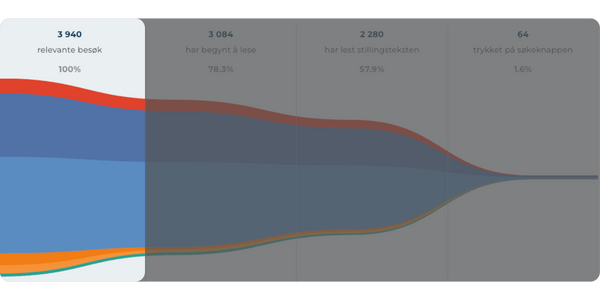
Initial engagement
This is the initial engagement metric, counting page visits but excluding things like accidental clicks and other noise.
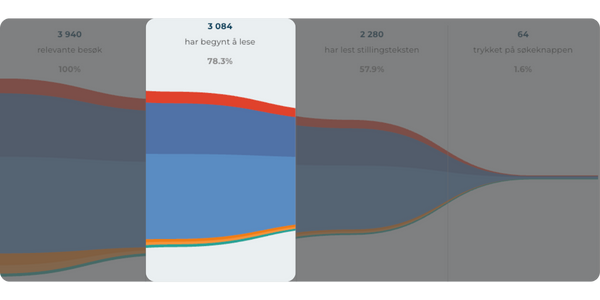
Second degree of engagement
The second degree of engagement tracks the number of visitors who start scrolling down the page.
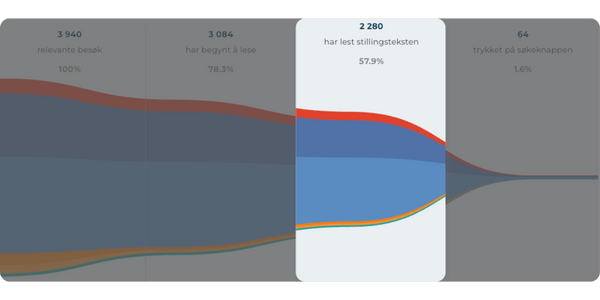
Third degree of engagement
The third degree of engagement, our primary metric for impact, counts users who spend substantial time on the job ad and interact with a certain amount of measurement points.
Why are theese metrics useful?
We measure engagement levels on your job ad not just to report fancy statistics. Measuring impact helps us target your job to the most relevant audiences while optimizing your ad spend.
Unlike other solutions, our technology provides behavioral insights into what happens after someone clicks on your ad.
Traditional job marketing often focuses on metrics like clicks and impressions, which show visibility and traffic, but not the quality of the traffic and level of engagement on the job ad.
High numbers for views and clicks can be misleading as they’re of little value if they don’t result in the desired action on your job campaign page.
For example, an ad may receive 5,000 impressions and 800 clicks, yet candidate engagement data reveal that only 5 users showed a high level of engagement and none applied for the position.
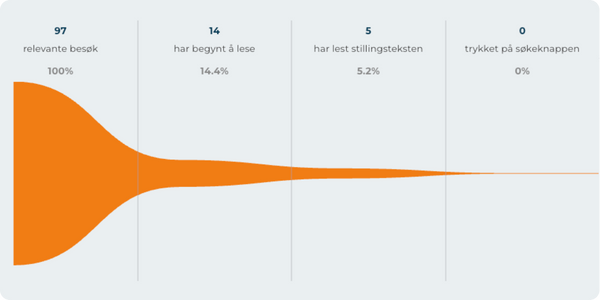
Data-driven job marketing goes beyond clicks and impressions, analyzing what happens after someone engages with your ad in social media or on other websites. It measures traffic quality and show the real impact of the marketing for your job ad. It focuses on real value and outcome rather than just visibility.
Measurements of engagement data is analyzed to continuously optimize your marketing, ensuring your job reaches the most relevant audience possible.
Traditional methods
- Surface metrics like views and clicks
- Doesn't reveal post-click behavior
- Challenging to make adjustments based on facts
- Less control
Data-driven job marketing
- Measure post-click behavior
- Allows optimization based on engagement level
- Smart use of ad budget
- More control
The combination that makes impact
By combining insights from user behavior on the job ad with impressions and clicks from each channel, we can pinpoint what truly works and which actions produce the best result.